
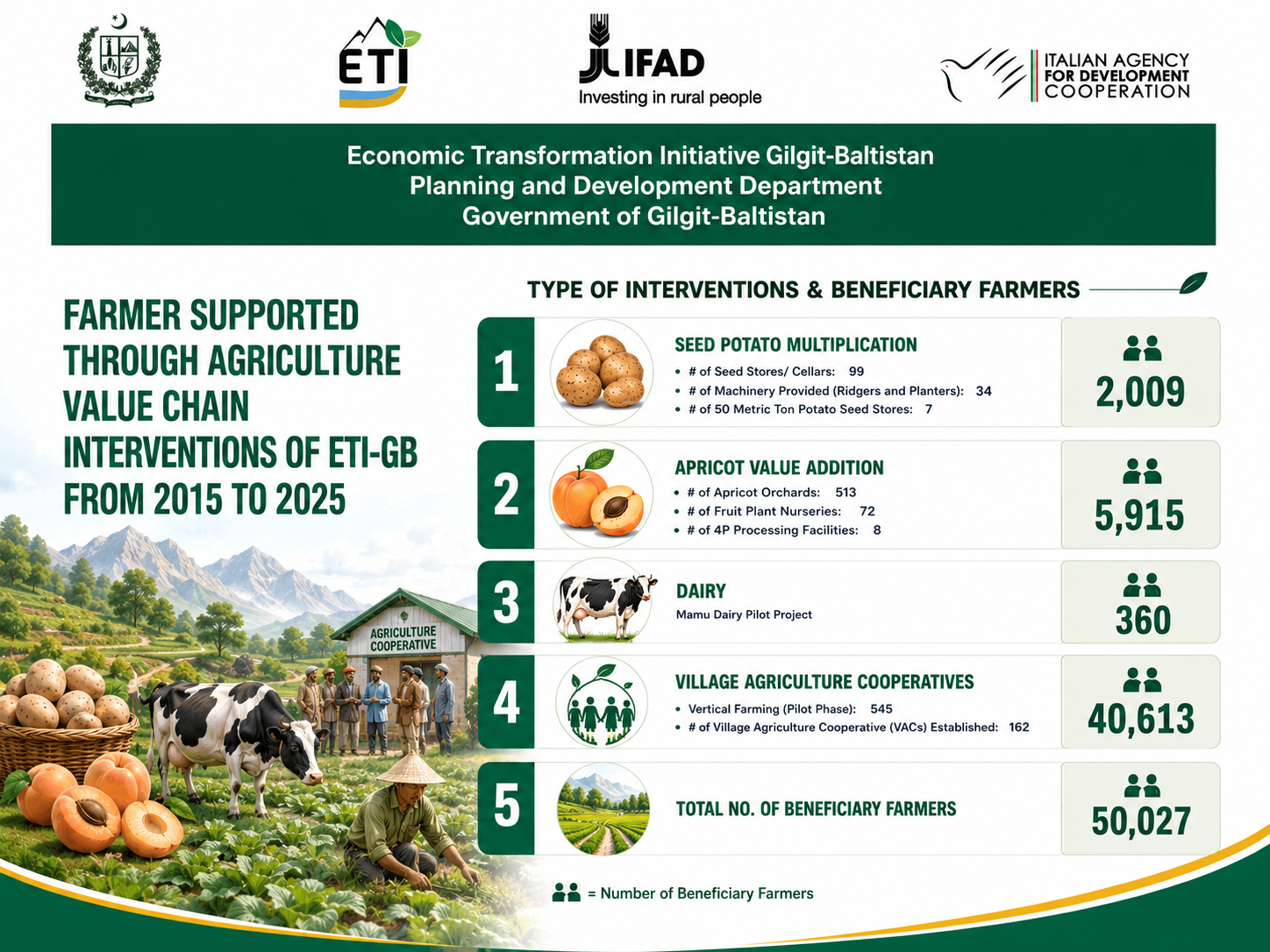
An agricultural value chain is the range of activities required to bring a product from farm to market. ETI-GB supports value-chain development with an initial focus on apricot and potato, and other potential chains thereafter, across all ten districts of Gilgit-Baltistan.
Benefits are expected from more optimal use of inputs, better practices, value addition, and joint marketing and input procurement. These include higher productivity, reduced losses and better prices. The component is commercial and market-oriented, working through organized farmer groups — Village Agriculture Cooperatives (VACs) — and other value-chain actors, following a 4P approach that links producers, the public sector and the private sector.
Sub-components
Value Chain Development consists of four operational sub-components, plus related land-titling work for irrigation beneficiaries:
- Value Chain Support Fund — matching grants to meet financing needs of farmers, organizations, traders, processors, packagers and exporters.
- Social Mobilization — organizing farmers into groups and associations to address scattered production, aggregation, quality control, and links to extension and research.
- Agriculture Extension — demand-driven extension services to organized farmers.
- Agriculture Research — addressing the shortage of quality potato seed through farmer- and contract-centred seed production, and related research support.
Progress
Over 40,900 farmers have been organized under 162 formally registered Village Agriculture Cooperatives. Business plans aimed at incremental income have been developed for all VACs. ETI-GB has invested over Rs. 1.4 billion to support farmers around 20 agricultural commodities, addressing pre- and post-harvest losses, quality improvement, collective marketing and linkage development. Commodities include apricot, cherry, apple, nuts, and open-field and controlled vegetable production such as cucumber, tomato and capsicum. VACs also received office-management grants. Results include increased production, better quality, value addition, collective marketing and stronger links with promoters, raising farmer incomes.