
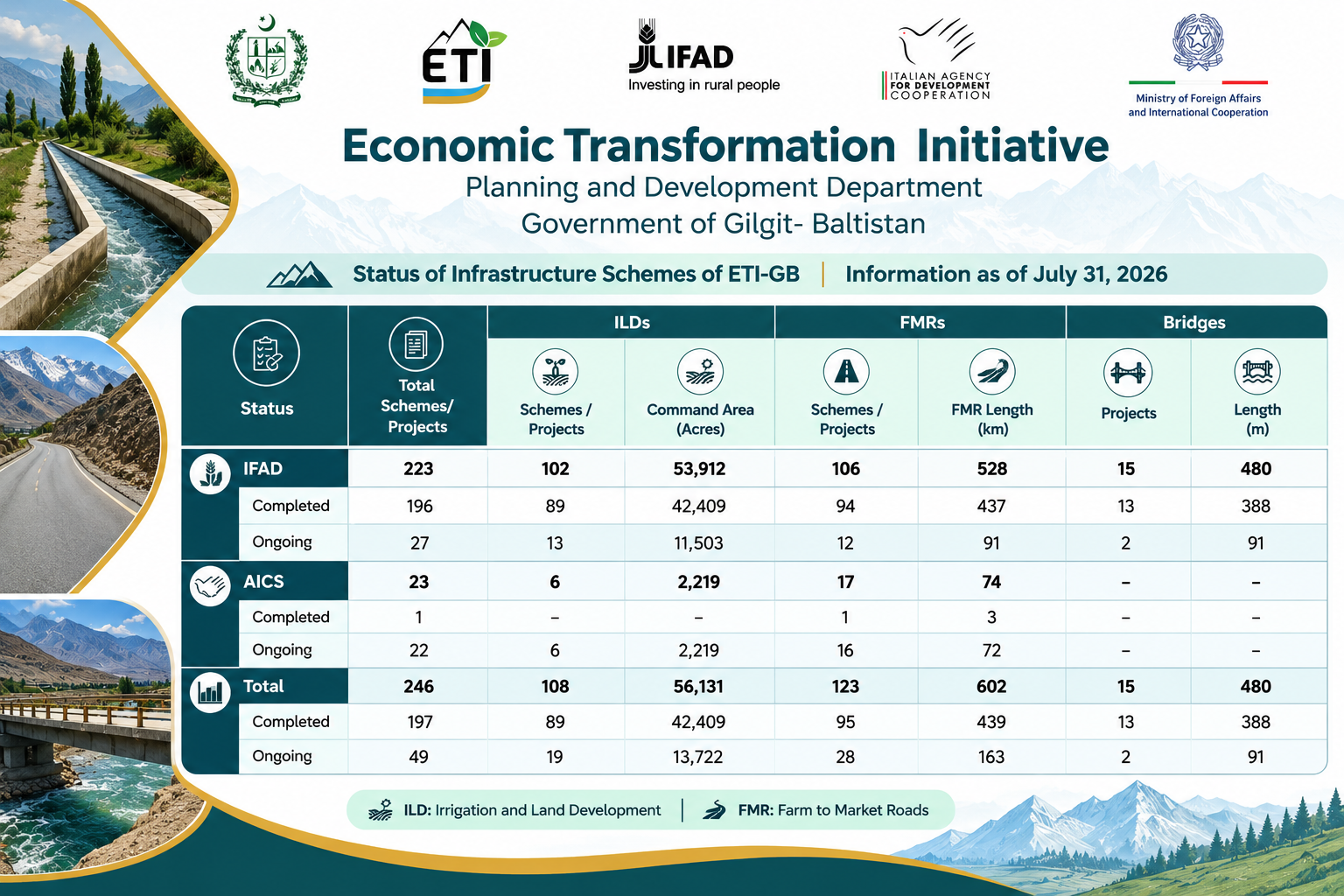
This component substantially increases irrigated area in the target districts and improves access to markets through upgraded road links. It is the largest part of the programme, covering about 60% of the base cost, and consists of two sub-components: Irrigation and Land Development (ILD) and Farm to Market Roads (FMR).
The programme follows a holistic, community-driven approach that is pro-poor and sensitive to gender, youth and nutrition. Through social mobilization, communities are linked with government extension and research services and with the private sector.
Irrigation and Land Development
ILD develops additional irrigated land across all ten districts of Gilgit-Baltistan. Priority is given to larger command areas, with inter-district balance and equity in phasing. Schemes are implemented with the Water Management Directorate and, for larger works, the GB Public Works Department, using a participatory model in which communities recover 50% of construction cost into a community account for future social and economic investment.
Farm to Market Roads
FMR improves critical road links for supported value chains, connecting production areas to valley roads and main roads. The sub-component upgrades pony tracks to jeepable roads and jeepable roads to truckable roads, and includes bridges where needed. The Programme Coordination Unit oversees procurement and quality; GB PWD implements works in coordination with the Water Management Directorate and social mobilization partners.
Progress
Under this component, 78 ILD schemes with a total command area of over 42,600 acres and 384.6 km of farm-to-market roads have been constructed. A further 28 ILD schemes covering over 16,800 acres and 21 roads with a cumulative length of 122 km have been approved and are at various stages of implementation.